Shivneri (Malshej Ghat Region)
7th Feb 2005
The stopover hike
When Aravind & his family, amma, appa visited us in Pune, we went on a short holiday to Bhimashankar. As we were driving back to Pune, Rohit spotted the sign – Shivneri, just off the route. Birthplace of Shivaji. We looked at each other, and that was that: we were going.
It was one o’clock by the time we reached the base of the fort, and the sun was absolutely merciless. Amma and appa took one look at the climb and made the sensible call – they found a tree with decent shade and settled in to wait for us. I envied them slightly.
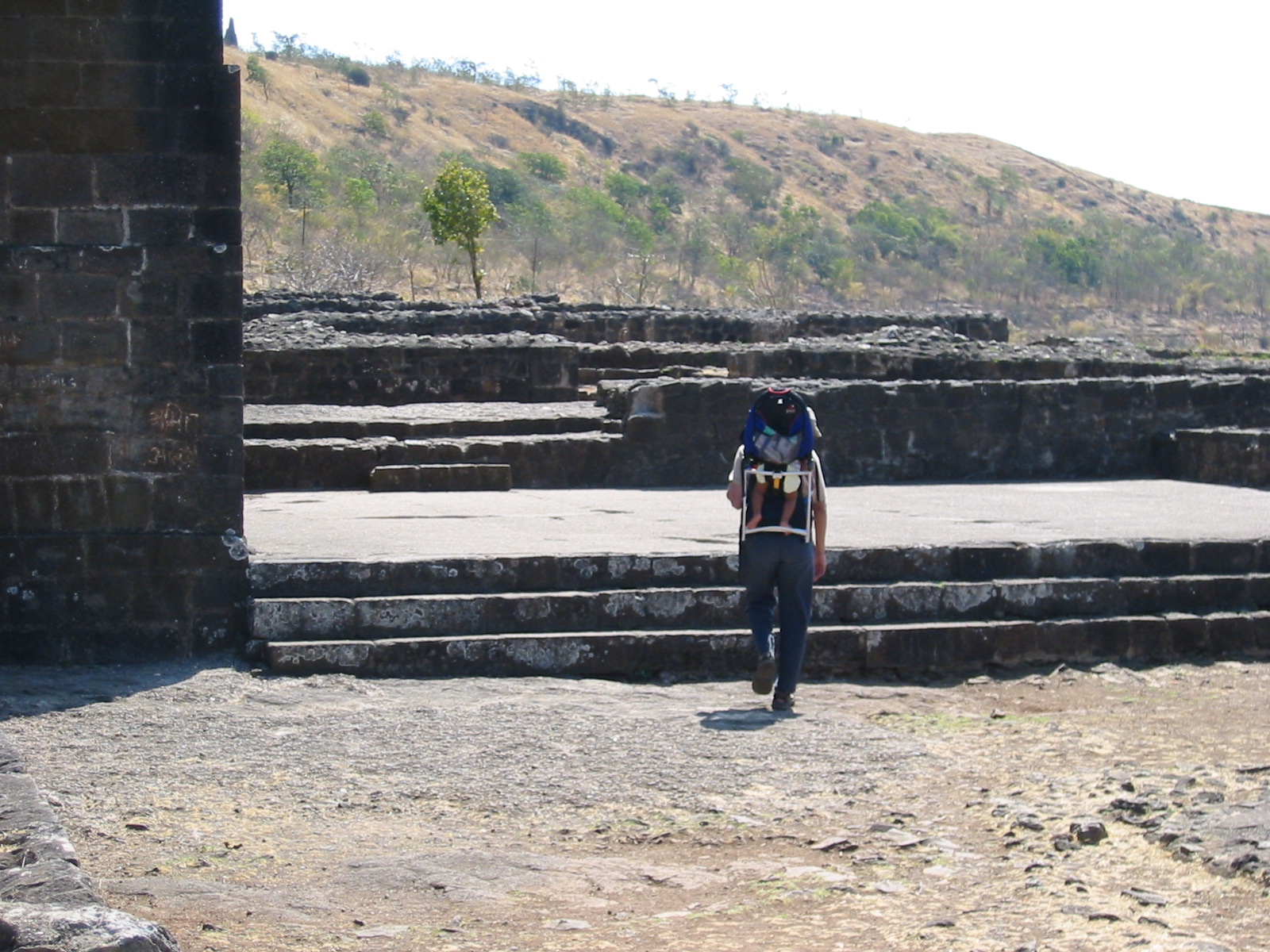
The rest of us started up. It was after all not that high, just a potato hike – but the sun makes it a fried potato hike. Shishir rode the whole way on Aravind’s shoulders, which seemed like either great fun or slow torture depending on which of them you asked. Akash was in the Kelty on my back, blissfully oblivious to the effort involved.
At one of the turns in the path, the valley opened up below us – a large water body lying flat and pale in the afternoon glare, the fields around it impossibly green from up here. Later looked it up to be the Manikdoh reservoir. About the dam and surrounds
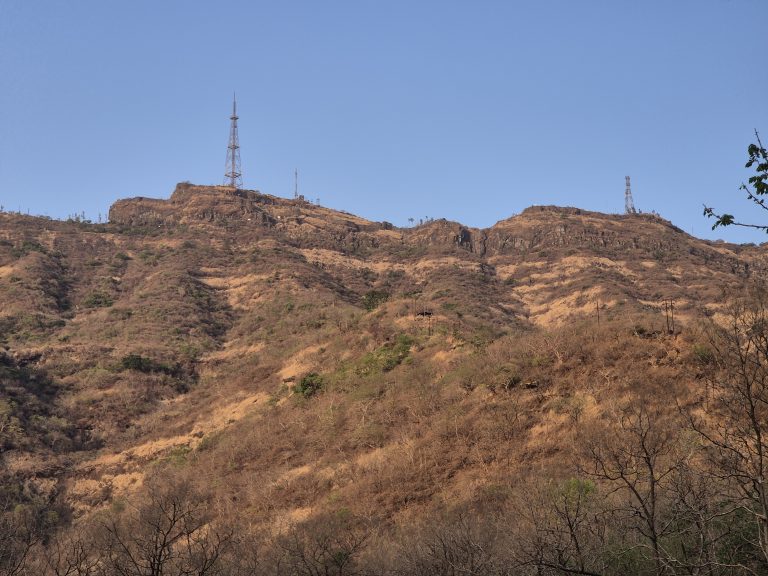
On the hill and path though, it was rocky and dry. A diametrically opposite view of the Sahyadris, at its furthest moment from monsoon rains. Brown, bleached hay, contrasted with dark rocks. The hillside was covered in it – prickly pear jostling for space with tall, branching euphorbia, that distinctly Deccan combination of succulents that makes the February landscape look ancient and dry.
Akash surveyed all of it from his perch with complete seriousness. The close-up I took of his face says everything: chin propped on the carrier edge, brow furrowed, utterly unimpressed by the view, or by me, or by the whole enterprise.
There is one tree on the path that stopped me – a huge, dramatically bare, contorted thing, its branches spreading in every direction like the whomping willow from Harry Potter.
Higher up, the silk cotton trees were blooming – bare of leaves but scattered with red-pink buds just beginning to open against a hard blue sky. I kept stopping to look up at them. February is their moment. The Indian cherry blossom was out too – small clusters of pink flowers on bare branches, unexpectedly delicate against the rock.
The fort has seven gates; you pass through them one by one. The gateways are beautiful – ornate carved arches with fluted pilasters, though most of them have been thoroughly graffitied by now. Walking through one of the lower fortress doorways, I caught Lalitha and Aravind as silhouettes framed by the arch, the rock and sky beyond them. Inside, in the shade of one of the gateway passages, we stopped for water. Shishir took charge of his sippy cup with great concentration, then looked up and grinned the biggest, wettest grin.
The views at different points were worth it – the kind that make you stop and stare and forget for a moment that you are sweating through your clothes. But the heat was punishing, and somewhere around the halfway mark Aravind and Lalitha decided they’d had enough and turned back down. Rohit and I pushed on and eventually reached the top, where the breeze was a small mercy.
At the top, the fort spreads into a series of structures and courtyards – the birthplace building, a mosque ruin with a broken minaret standing against the sky, a two-storey façade with arched niches and windows, all of it dark basalt stone, graffiti-covered, half-ruined and still imposing. I stopped at the carved pillar base near the entrance to the birthplace – lotus petal carvings worn smooth, beautiful even in decay.
One of the water tanks (I think it’s called the Ganga Jamuna Talav) near the top was completely taken over by algae – a vivid, almost unreal green, the colour of a swimming pool, with dead branches hanging over the surface and their reflections wobbling in it.
From the wall edge at the top you look almost straight down. The fort drops away on sheer cliffs, a hardy pepal growing straight out of the stonework halfway down, and below that the valley – Junnar spread out below, fields and roads and the long glitter of the Manikdoh reservoir.
At some point Rohit took over the Kelty – Akash moved from my back to his, and fallen asleep in the carrier, slumped sideways, chin on the edge. Negligent parents that we were, we didn’t think to put a hat on the poor baby (though we ourselves had hats on). In retrospect, I don’t forgive myself for this.
We got back down around half past three. We found Amma and Appa exactly where we’d left them, entirely unruffled. Lunch was late and very welcome, at a place near the fort, and we rolled into Pune around six.