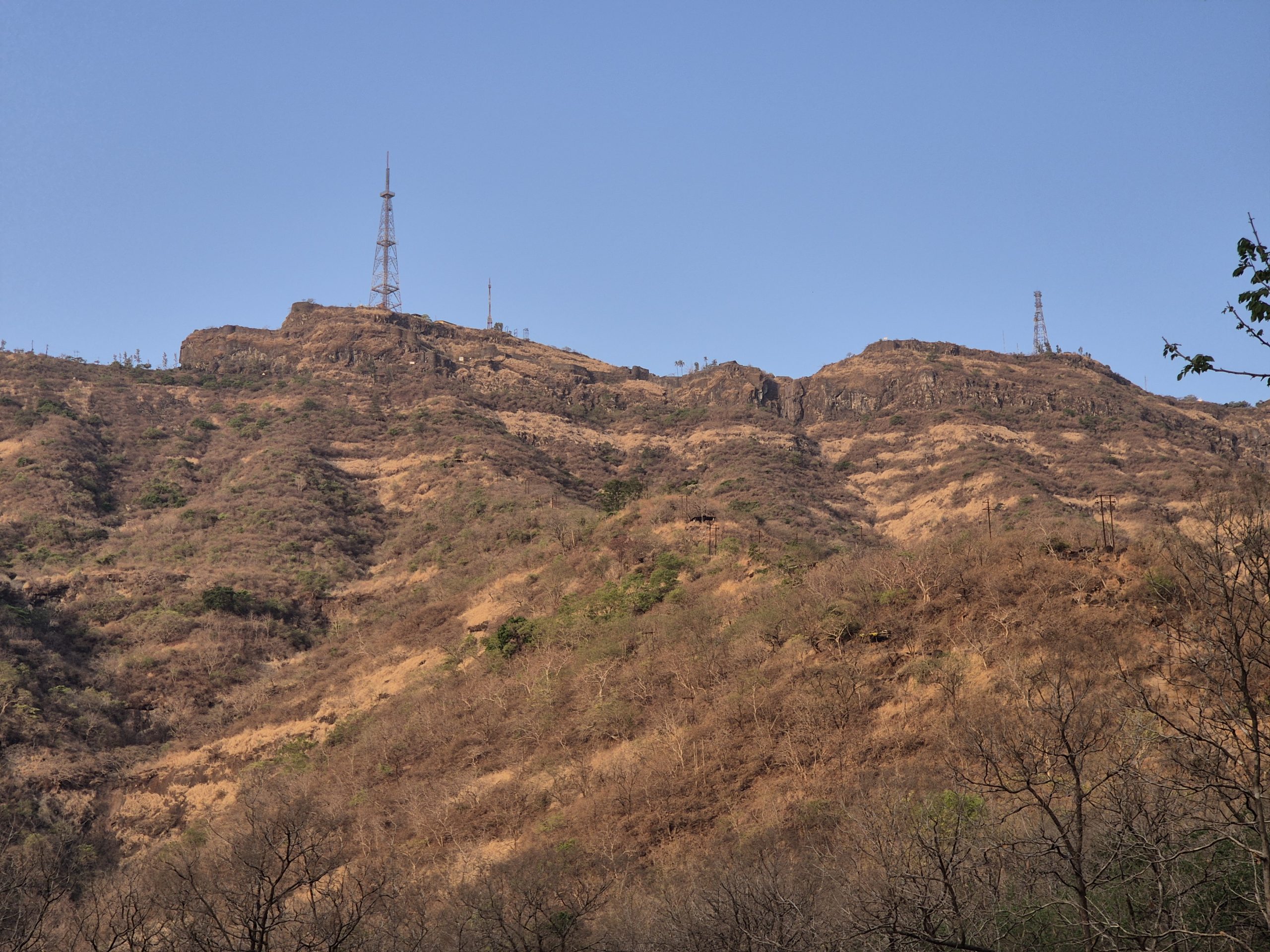
Sinhagad, the anchor trek (Pune Region)
We went up Sinhagad countless times. Being the closest non-trivial trek to Pune city, it was the go-to trek, not only for us, but for the whole Puneri trekking community. Pune, being an industrial city, had Thursdays off – so Thursday morning was a popular time for the hardcore trekkers to be there. The more hardcore one was, the earlier they went. Many times, starting to trek up at 6:30, we’d encounter enthu-punters coming down at that time!
The scenic drive
From Pune to Sinhagad used to be a 45 min drive in the 1990s. Now, depending on where you start from within Pune, it can be upto 3 hrs, as the city has sprawled considerably.
But once you get out of Pune via Pashan, the scenic drive starts. You drive through the well maintained army area with broad roads lined with palms, gulmohars and jacaranda trees. Depending on the season, they are flush with orange or lavender blooms respectively. Pashan Lake flickers past – nothing much to look at really, hemmed in by construction and scrubby growth, it’s unremarkable on a clear day. But catch it with mist floating over it and it’s briefly, improbably beautiful.
After the kids, we have gone by car mostly, and that’s not as special, though the destination remains special. Yet, Sinhagad and the motorbike rides to get there in the early days, are inseparable in my mind. With the wind in my hair, the early morning serenity enveloping me, this bike ride was an integral part of the experience. Well if you want to get technical, I wore a helmet most of the time – so only very occasionally let the wind actually in my hair!
Riding a while after leaving the city, you pass through the army area around Khadakwasla lake. The lake itself is a popular local destination, and usually on our ride back from Sinhagad we see vendors setting up stalls preparing for the day. It fully earns its popularity: it’s a huge sprawling reservoir formed due to the Khadakwasla Dam on the Mutha River. In the early morning with mist hanging low over it, it competes with any famous Scottish loch for beauty.
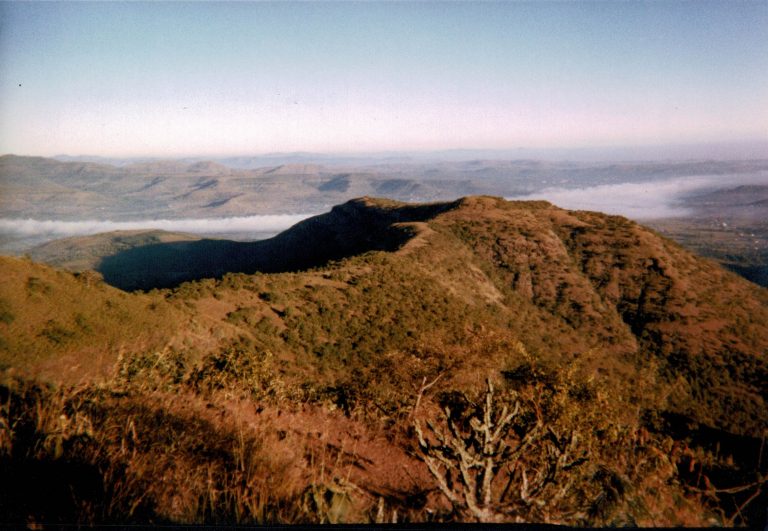
From across the Khadakwasla lake, you catch your first glimpse of Sinhagad: I think of it as magic mountain, floating above the mist, the distinctive tabletop mountain with its TV tower.
You pass some small villages further down. Narrow streets, connected to Pune via a periodic ST (State Transport) bus. Sometimes you pass this bus on the way – dusty red with yellow accents, trundling along to Sinhagad. There’s a fork at one point – the left leading to the winding road to the parking lot at the top, and the straight (or right) leading to the base for the trek. The bus goes to the base. You park your bikes at one of the little establishments around the base, which serve breakfast and offer rudimentary toilet facilities, and keep an eye on your vehicle for a small fee.
This area is already gently sloping up, with big flat stones paving the path. On either side you see young teak trees with their broad rough leaves. Makes for great photographs with the early morning sun angling in between the trees – and just like that, the trek has begun.
The trek
There is a main broad path that starts out of the base village with the paved stones, and soon gives way to a steep hill path, still quite wide. After an initial climb of about 10–15 mins, you come to a clearing ringed with trees. A breathing moment, and photo-op for those so inclined.
As you continue up, the thing you notice is that the trail stays demanding and steep. Never quite lets up. There are ragged shacks at intervals, where vendors setup their taak and limbu pani stands – but never this early in the morning. From 4 am to around 8 am, you see no one but other trekkers. The earliest I’ve started is around 5:30.
In the lower parts, you have the mountain on one side and a sheer drop and view of the valley on the other. The sun starts climbing over the ring of hills opposite – and the main game is trying to beat the sun. If the sun gets a bit high, it beats down on you mercilessly on the unexposed sloped above. So the earlier you start, the better chance at being on top before the sun. Or go in the monsoons when the clouds give you cover.
Most regular Puneri trekkers keep to themselves – either solo or in small groups of two or three. When you encounter them on the trail, don’t expect a friendly word or smile. They’re the strong silent type for the most part. Can come across as gruff and unfriendly – even if you greet them, they’re caught unawares, and only manage to grunt back – if that. The regulars must know each other at least by sight, and sometimes you see a secret nod pass between them.
And up and up you trudge. The trail opens to the sky at some point. You have a 360 degree view of the other hills in the area, and Khadakwasla lake far below. Around two thirds of the way, I always feel like “ah, this is cool, I am not tired, it’s a breeze!” but soon after – at around the 75% mark, I flag. Invariably. Especially if foolish enough to start as late as 6:30 am. The sun is up doing its business, and I wilt. It becomes a battle of will to keep putting one foot in front of the other. Thinking no other thoughts. Seriously good meditation. Even when walking with others, I find that I am solo, mostly within my own head, on these walks. It’s become such a natural way of being, that I hardly stop to think about it. Now I must say I like this mode. The bonus of having company: occasionally I surface, exchange a word or smile, then go back to plodding.
The last bit – say 10 mins of walking, is along a closed-in path. Rock and bushes on either side, the path zigzagging steeply up. Sometimes you catch a glimpse of the end – which is a rock wall to which this path leads. Last part is some steps to a gap in the wall. If I’m with others, invariably they’ve all reached the wall before me. They’re sitting on the wall dangling their feet, waiting for me.
The ascent and timing
Sinhagad is a climb of ~600m from base to this wall, which is seen as the official end of the trek. You can climb higher to the plateau and explore the fort, but that’s a different activity.
The fort is about 760m from the base, and ~1300m above mean sea level.
I am anywhere from 5–25 mins behind the others usually. I take an hour and 20 mins, last checked. Ak likes to say he could do this in 45 mins if he wasn’t dragged down by me – I think true, because the regulars do this in 45 mins.
Shivaji’s Fort at Sinhagad
Shivaji’s Fort up at Sinhagad is a huge sprawling complex – worth the visit for itself. In fact, many casual sightseers come by vehicle to the parking lot near the top, and visit the fort. It’s “just” a 20 min walk from the parking lot to the top of the plateau – up 2 or 3 gentle flights of stone steps, through two open stone doorways, the first is called the Pune Darwaja (doorway).
On the plateau, there are a lot of little shacks and one or two structural restaurants ready for the visiting public. They serve traditional Maharashtrian fare of kanda poha, batata vada, kanda bhaji, thalipeeth, and taak to name the most popular dishes.
Shivaji Maharaj used the steepness of this hill to his strategic advantage, building his fort here with a great view and natural protection against his enemies. You can see them coming from a long way off. In fact, many of the other treks in Maharashtra lead to one or other of Shivaji’s strategic forts: Rajgad, Torna, Purandar, Sudhagad…
Pune Darwaja is the entrance used nowadays, and on the other side is the other entrance, the Kalyan Darwaja. The Sinhagad was initially known as “Kondhana” after the sage Kaundinya.
The fort has a fierce history, changing hands multiple times since the medieval ages. One of the most famous battles for Sinhagad was fought to recapture the fort by Shivaji’s general Tanaji, in March 1670.
Tanaji heroically scaled a steep cliff face of the heavily guarded fort, using a trained giant monitor lizard named Yashwanti (or Ghorpad) with a rope tied to its waist. Reaching the top, he secured a rope ladder to the sheer cliff, allowing his soldiers to scale the wall.
The fort was renamed Sinhagad (Lion’s Fort) in honor of Tanaji, with Shivaji famously remarking, “Gad ala pan sinha gela” (“The fort is captured, but the lion is dead”). Ref battle of Sinhagad story by Jagranjosh
Showing off Sinhagad to my visitors
I’ve taken every visitor to Sinhagad over the years. My parents in their 60s – we took them up as pillion riders on our motorbikes. My kids of course – multiple times, either on my back with the Kelty Kids baby backpack, or on their own steam when a bit older.
Akash’s first visit was in August 2004, up the easy way by car, my parents accompanying. We went again for his 4th birthday in 2008, taking his friend Ananth along and Aditi in the baby backpack. By September 2009 he was walking up the full trail himself, with a group of my Cisco colleagues. Any sporting visitor got the Sinhagad treatment.
Monsoon was (and I suppose is still) a special time to go into the hills around Pune: everything turns such a vibrant green. For me personally, the uplift it brings is indescribable. When Lynne and her partner Phil visited me in Pune, took them up Sinhagad too, promising them a special treat – a monsoon trek! Coming from England, where it rains a majority of the time, a monsoon trek for them was not the exciting event that it was to us locals. In the rainy season, the trail turns to a wonderful red slush in parts, and mossy slippery rocks in other parts. Though experienced travelers and hill-walkers, they experienced it as a bit of a dangerous walk, living on the wild side and so on. Unfortunately, a snake happened to slither across the path on the day Lynne and Phil came – not a regular occurrence by any means. It was a harmless grass snake I think, but it added to the wild tropics storyline for them. Slushy path, slippery rocks, snakes and all, without quite meaning to, it became an unforgettable experience for Lynne.
Recently (May 2025) I finally brought B to Pune to show him my usual haunts – Sinhagad of course among them. Ak accompanied us on the climb that time.
Here’s to many more Sinhagad climbs, mind and limbs willing!