Imaginative, eloquent – a flowing, easy read for kids and adults alike
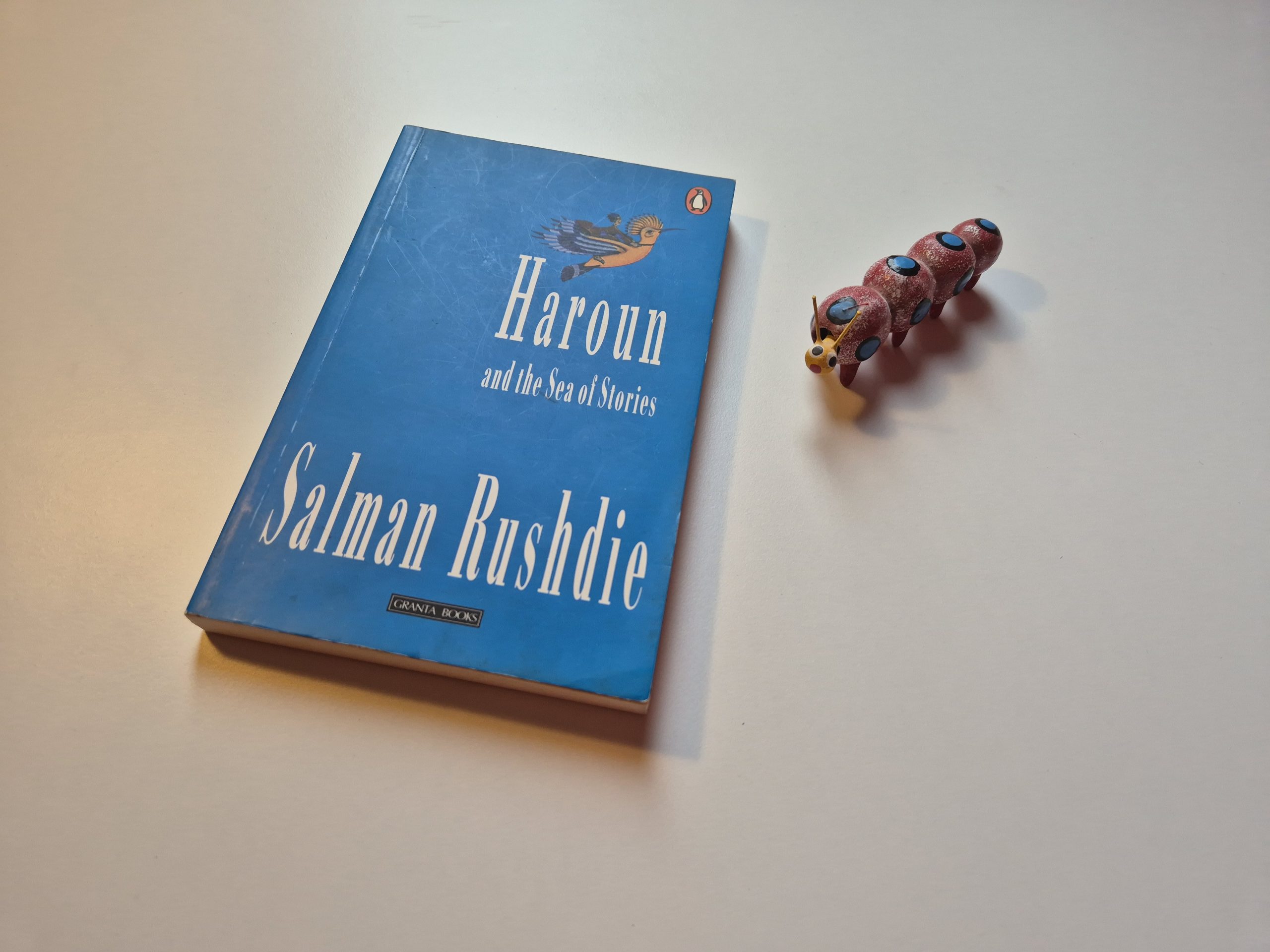
Haroun and the Sea of Stories by Salman Rushdie
My review on Amazon | Book on Amazon
5 out of 5 stars
Reviewed Aug 18, 2009
A story with a fairytale quality, that has a lyrical flow and makes it difficult to put down. It is an allegorical story which one can relate to at several different levels – from the superficial to the profound. Though it is positioned as a childrens’ book, adults can appreciate it just as well or even better.
It is a story of the adventures of a 10 year old boy Haroun in an imaginary world on a moon called “Kahani”. Haroun’s father, Rashid Khalifa is an extra-ordinary story teller who could bring smiles to the faces even of the people of the city that never smiles – the sad city. But after his wife leaves him, he loses the ability to tell stories. Haroun, though sad for himself, is much sadder about his father’s loss and desperately wants to fix things.
Haroun meets “Iff” the water genie, and convinces him to take him along to Kahani – where he can plead on his father’s behalf to get back his “unlimited subscription” to stories. Thus starts an amazing adventure on an imaginary moon, which has an “Ocean of Notions” – the source of all stories. This ocean and the stories in it are visualized beautifully, and brings in front of your eyes a shimmering ocean with colorful inter-woven strands of stories. This concept by itself is beautiful, and Rushdie has a way with words that makes this all come alive.
Somewhere along the way Rashid and Haroun visit the Valley of K (a thinly veiled reference to Kashmir), and Dull (Dal!) Lake. The description of this visit is an especially beautiful passage. The lake takes on the moods of Haroun when he sails in it – the blue-green waters serenely reflective at times, and grey and forbidding when Haroun is upset, and wild and turbulent when he’s angry.
Rashid too follows his son into “Kahani” moon, and they help in the war that is about to start there – between the “gup-wallahs” (identifying themselves with Light) and “chup-wallahs” (identifying themselves with Dark or Shadow). “gup” means talk or stories in Hindi, and “chup” means quiet (or shut up! based on context). The classic war between good and evil, light and dark. There is a careful effort to acknowledge the grey in the spectrum of good to bad (or light to dark). The war is waged to defeat the arch-enemy of the story teller, the evil “Khattam-Shud” (meaning “the end of everything” or “a final end” in Hindi). Khattam-Shud’s plot of poisoning the source of all stories within the Ocean, is foiled by brave young Haroun with the help of his new friends in the Kahani world – including the water genie and “butt butt butt” the Hoopoe, which is a mechanical flying machine resembling the exotic Hoopoe bird, and having the ability to reason and speak like humans.
There are a lot of creative characters woven out of concepts – such as the shadow dancer “Mudra” (meaning the unspeaking hand symbols used in classical Indian dance), the plentimaw-fish (fish with many mouths all speaking at the same time!), “Mali” the gardener of the ocean; then the concept of the army of Kahani being organized into “books”, “chapters” and “pages” (which are individual foot soldiers). This book is not only full of concepts but also written with humor, that has you laughing out loud in many parts.
As a result of helping win the war, Rashid gets his story-telling ability back, and Haroun is granted a wish – of course he asks for his mother back, and it all ends in a most satisfying fairytale way. Rushdie weaves a magic around his characters and you feel as though personally transported to Kahani and back with Haroun.
The author makes beautiful wordplay with the character names in Hindi and Urdu – some of this is lost if you don’t know those languages but for the most part, you still get a lot out of the story.
Once I told the story to my 5 year old son, he loved it, and it’s now a routine bedtime story at least twice a week!
An excellent read, highly recommended for all ages.