Ronda and Setenil – a Christmas Day escape
Christmas Day, off the train for once: a rented car, the gorge-spanning Puente Nuevo and white cliffs of Ronda, and the cave-street town of Setenil de las Bodegas.
(Day trip from Seville, 25th Dec)
Quick links to main sights
Views in and around Ronda | Puente Nuevo | El Tajo gorge | Setenil de las Bodegas
Should we stay or should we go
The days before Christmas, we debated whether to spend Christmas day in Seville, or get out and go somewhere. We had reserved at an Italian restaurant for dinner on 25th but it was unclear whether Seville cafés would be open during the day. Food, as ever, was part of the calculation: a week in, my vegetarian options had worn thin, and I half-hoped a new town might magically offer something new.
The tourist crowds everywhere had set me researching over-tourism in the region – and that research, ironically, turned up Ronda: an “off-beat” alternative, a town famous for its white cliffs and for the great arched bridge that leaps the gorge splitting it in two. Half-seriously, I looked into getting there. In the spirit of the trip we should have gone by train, but Ronda has only buses – and buses, in B’s worldview, are the worst of all transport, unreliable to the point of evil. There was a doable-but-awkward option: an early start, a single bus back at 18:30. We could just about pull it off.
Uncharacteristically, we left it to the last minute. On Christmas morning we decided to rent a car instead – the one day on the whole trip we left the trains behind. A last-minute deal turned up with a company neither of us knew, RecordGo (refreshingly hassle-free), and an hour of walking, bus and shuttle out to the airport to fetch it – public transport, naturally, to collect the car that would free us from it. And I wanted to “collect” driving in Spain. So I took the wheel, set the GPS for Ronda, 1.5 hours off.
After a week of trains, buses, and walking, the car felt like a luxurious potato day: an uncrowded road, our own pace, no platform queues or x-ray machines, no weighing carefully what to carry in my backpack.
Ronda
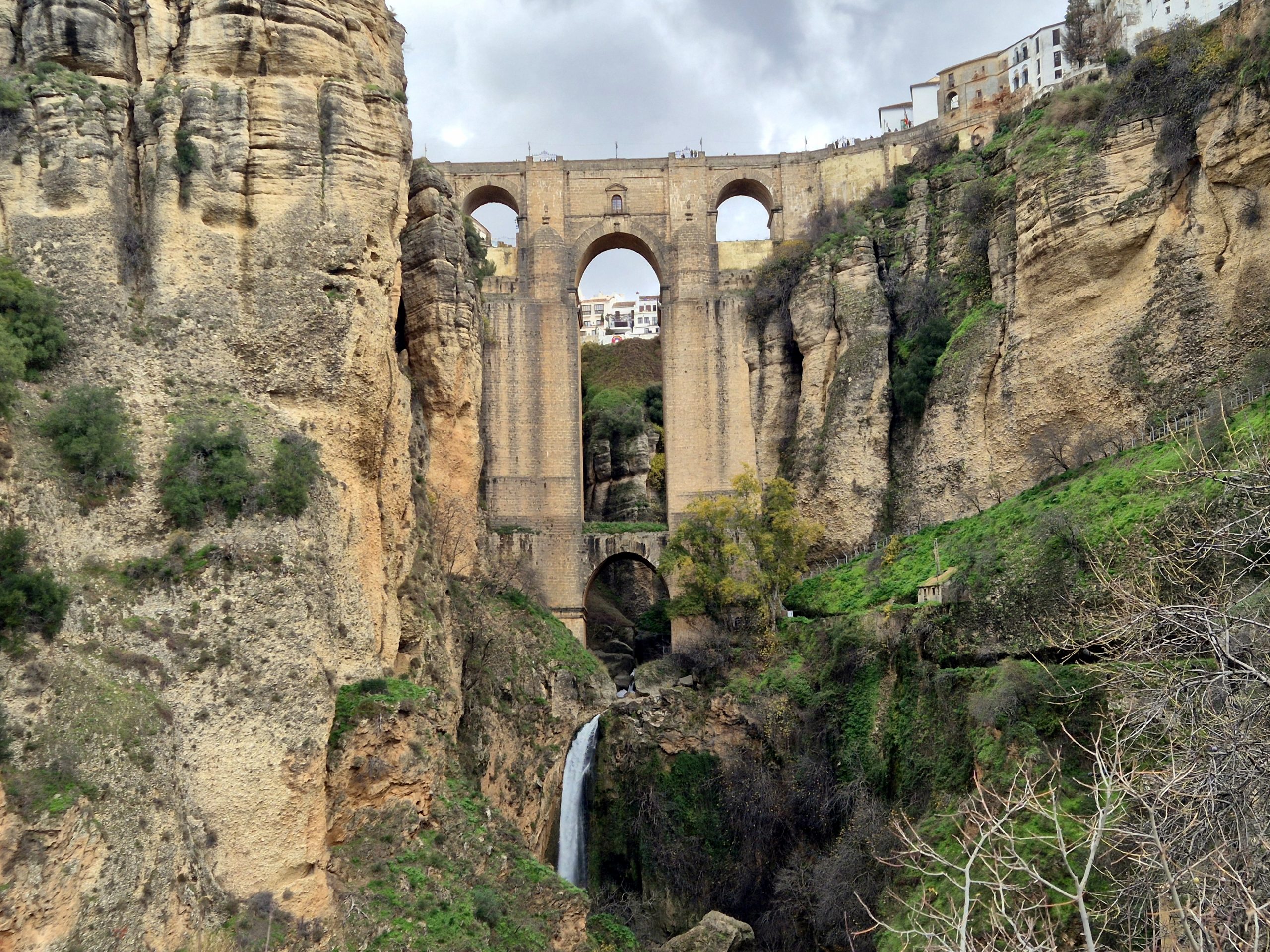
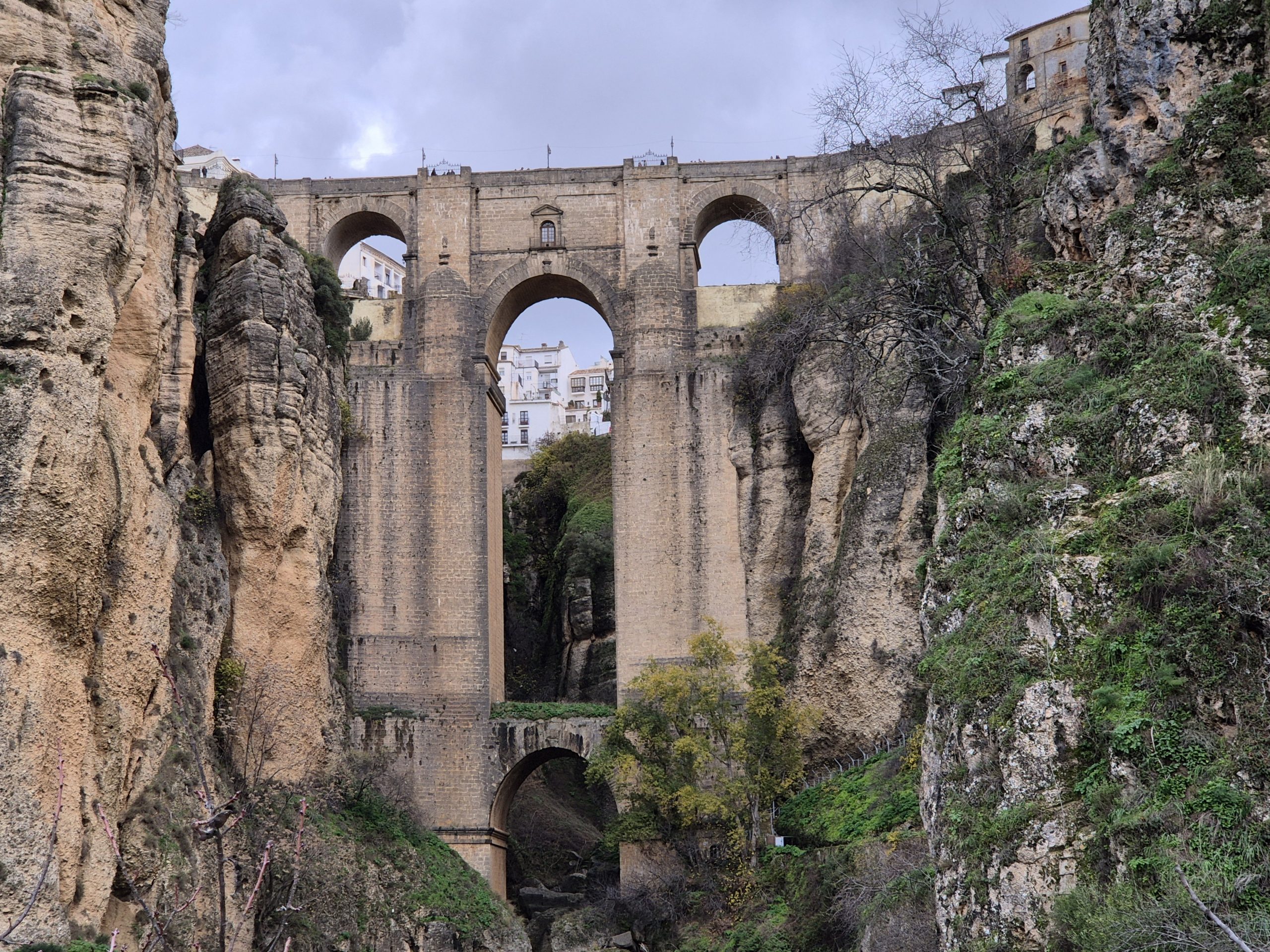
Ronda’s headline act is the Puente Nuevo, an enormous stone bridge flung across the El Tajo gorge that splits the town in two, the famous white cliffs falling away beneath it. We’d driven over the bridge on the way in without my noticing it. Parked and strolled through a pretty square, and wandered a bit aimlessly, assuming the weather was going to hold all day. A mistake, but we were not to know that then.
Found ourselves at the head of a path winding downwards, as if leading to the white cliffs in the distance. It seemed like the thing to do, so we went down it. I had mistakenly thought we were on this path to see the bridge. Or to get close to the white cliffs. But the further down we went, the more restless I got: no bridge, no white cliffs either. The bridge was slightly visible through foliage, high up off to our right, and the cliffs were really far in the middle distance. This path was pig-headedly winding further and further away from where I wanted to go. I watched as some ominous dark clouds started gliding towards Ronda. It increased my restlessness. At some point, we abruptly turned around and marched back up.
Now we had to hurry to beat the threatening rain clouds. I wanted to see that famous bridge! I wanted sunny photos of it! And we’d squandered away the sunny hour by walking down a no-good trail.
Shortly we were at the bridge. The upside was, we had dramatic light – sun and racing clouds – which made everything look staged for our benefit. From the Mirador de Martín de Aldehuela (named for the bridge’s own architect) the full drop and sweep of it open up. Not too crowded, but enough tourists around to make us feel at home. The threatening rain was not yet here. We lingered. We took in all the view points and lingered some more.
We stopped at a café right on the edge of the bridge – its terraces cantilevered out over the lip of the gorge – and I had, you can guess by now, a café bombón, looking out over the drop. Then the rain did hit. We watched from our cozy covered terrace.
A panel at the bridge’s interpretation center framed Ronda in a memorable way:
Romantic Travellers
In the 18th and 19th centuries, the young affluent of the increasingly industrialized Northern Europe went looking for a “lost paradise” in the picturesque south – and Andalusia, Ronda above all, became one of its favorite images. Washington Irving, Richard Ford, George Borrow; later Hemingway and Orson Welles, drawn by the bullfight, fixing an “unchangeable, romantic Ronda” in the world’s eye. Their impassioned books brought “first hundreds, then thousands, and nowadays millions” of visitors.
So the romance of those white cliffs had been drawing people for two centuries; here I was, humbly, one more of the millions.
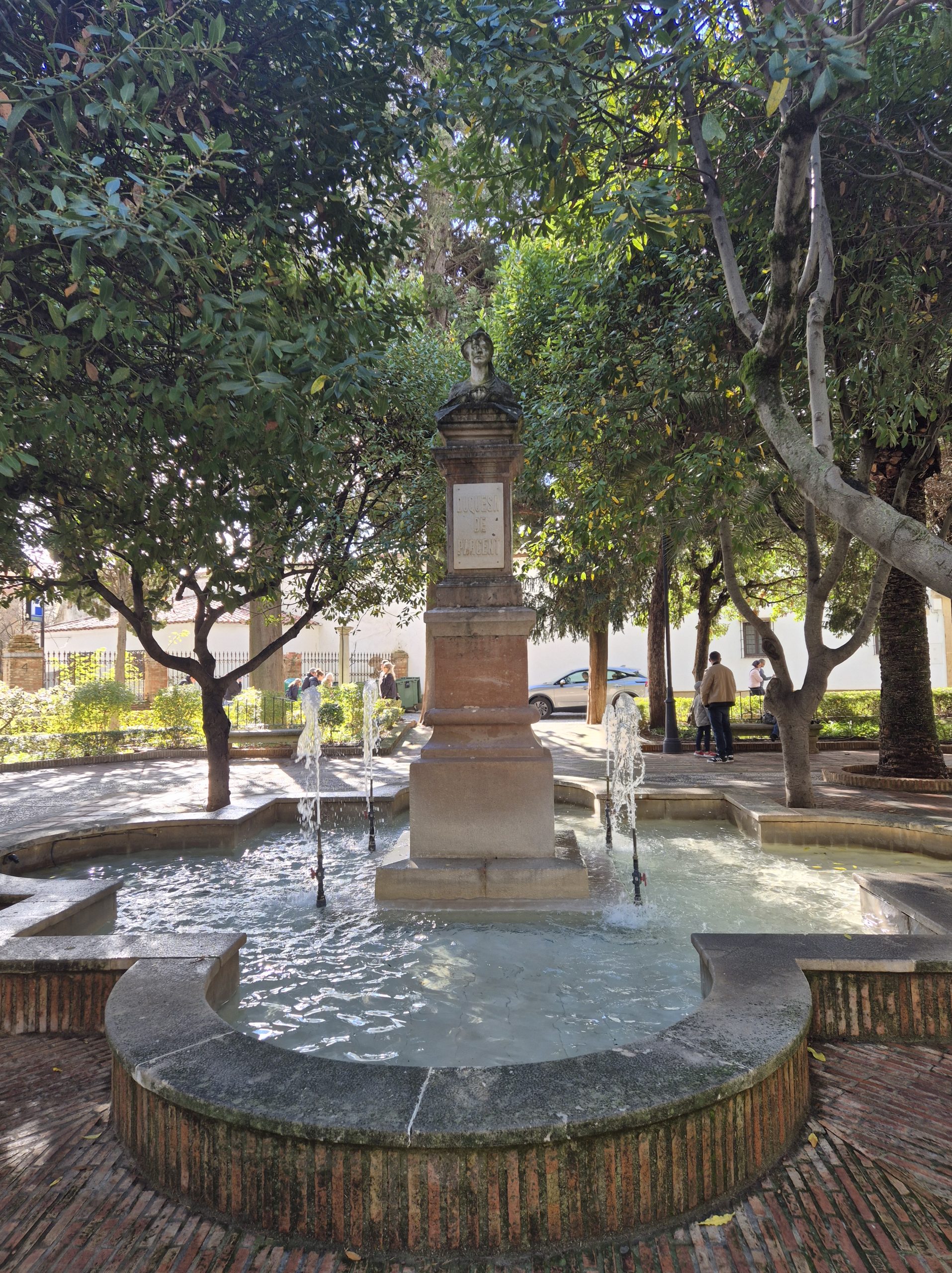
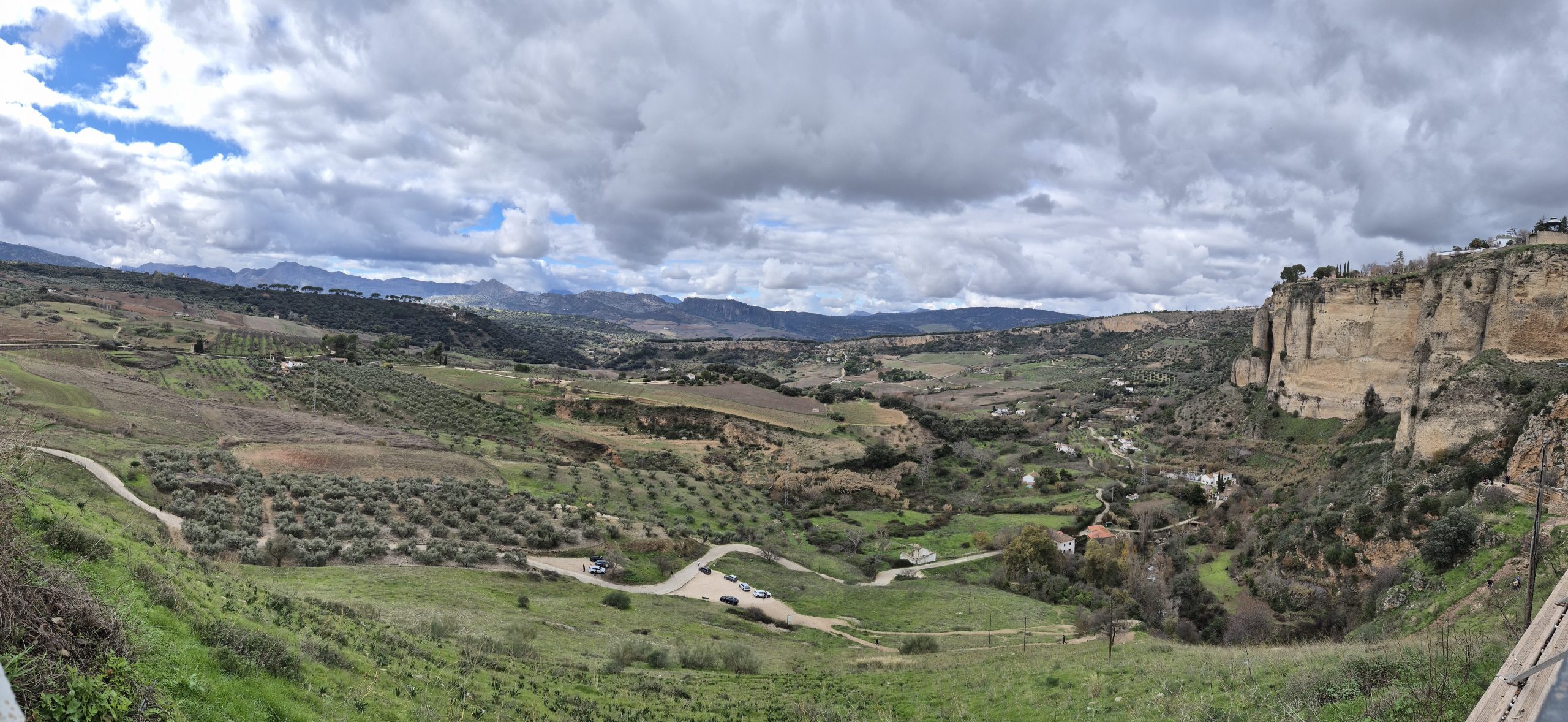
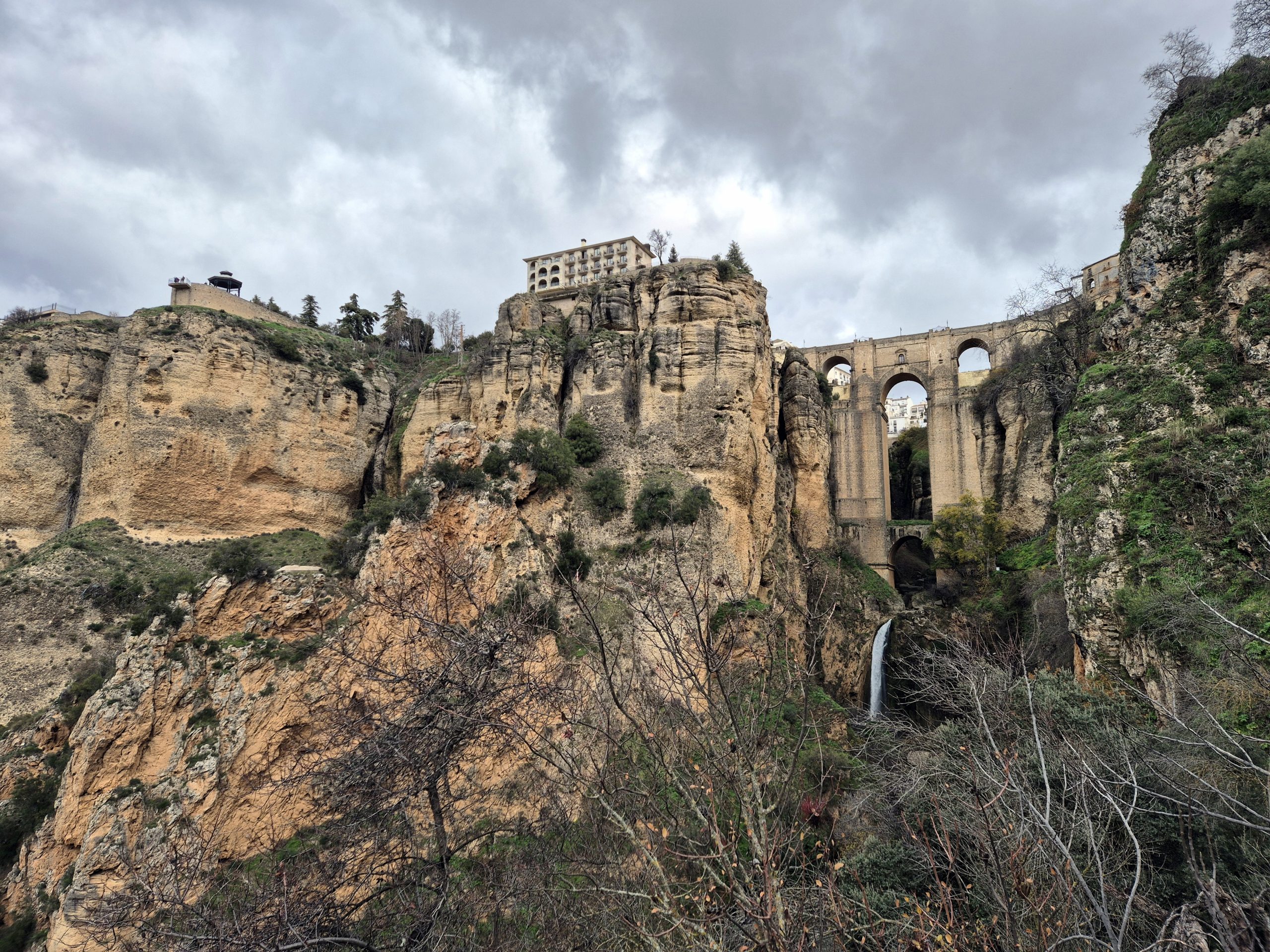
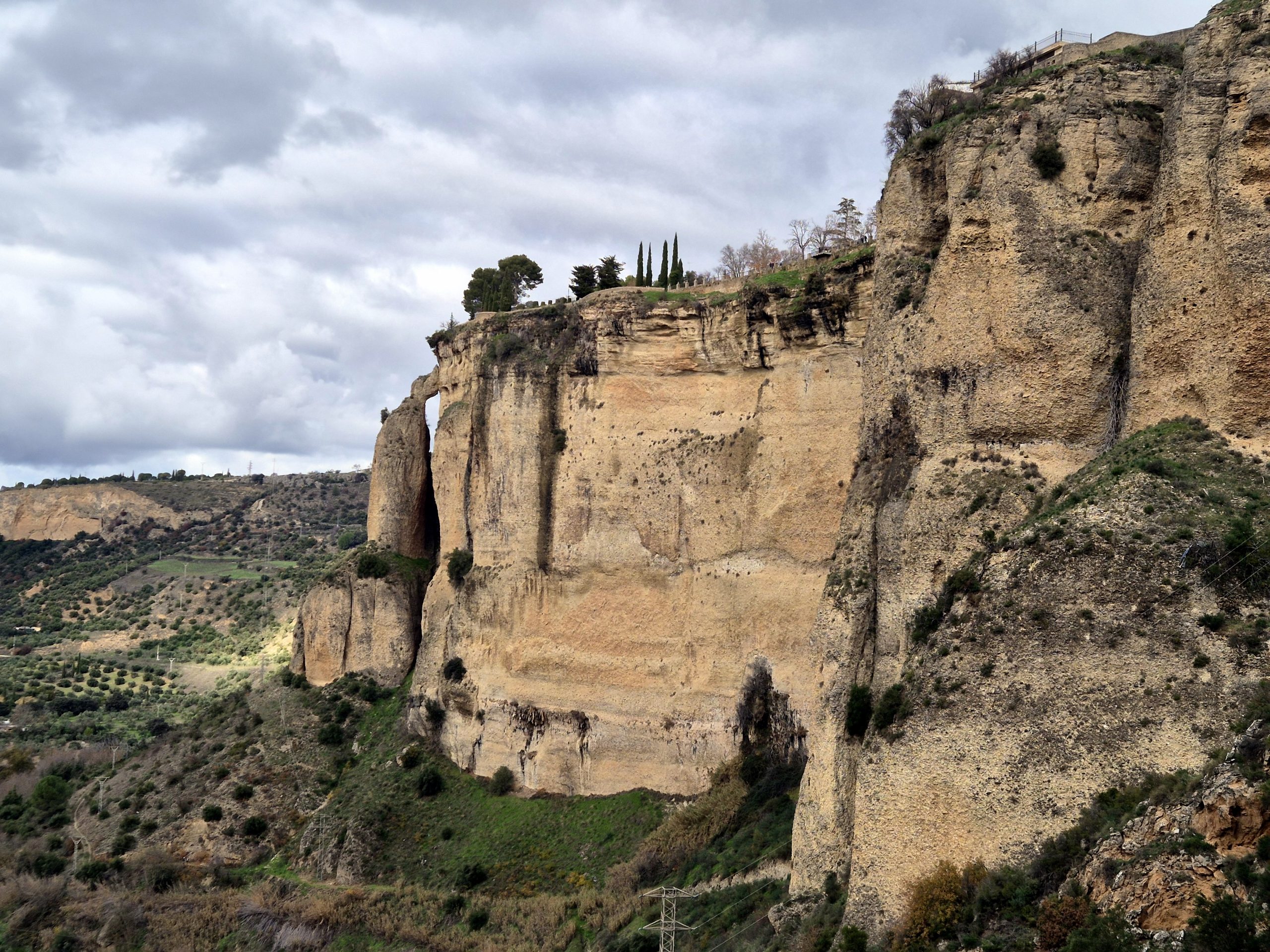
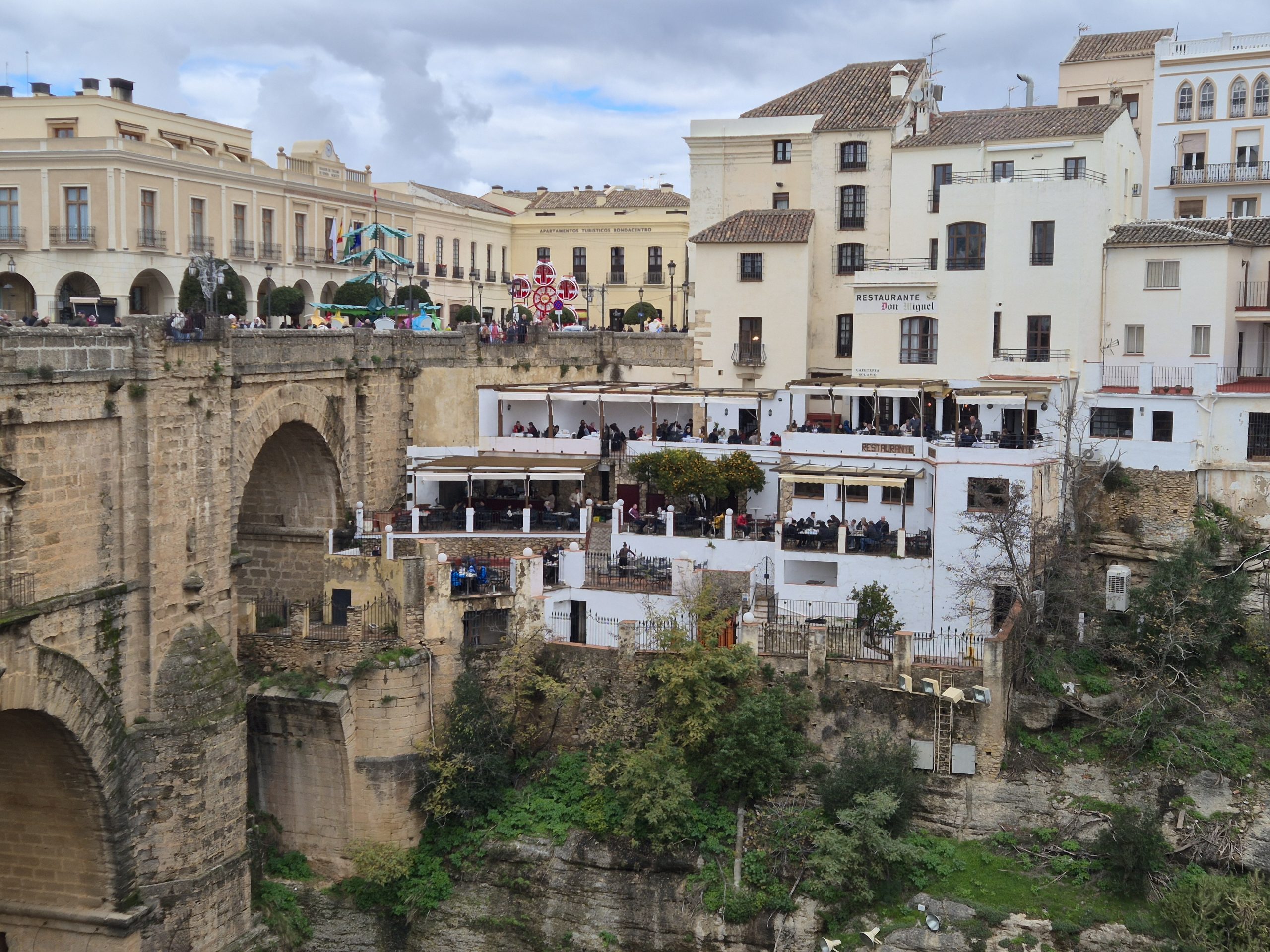
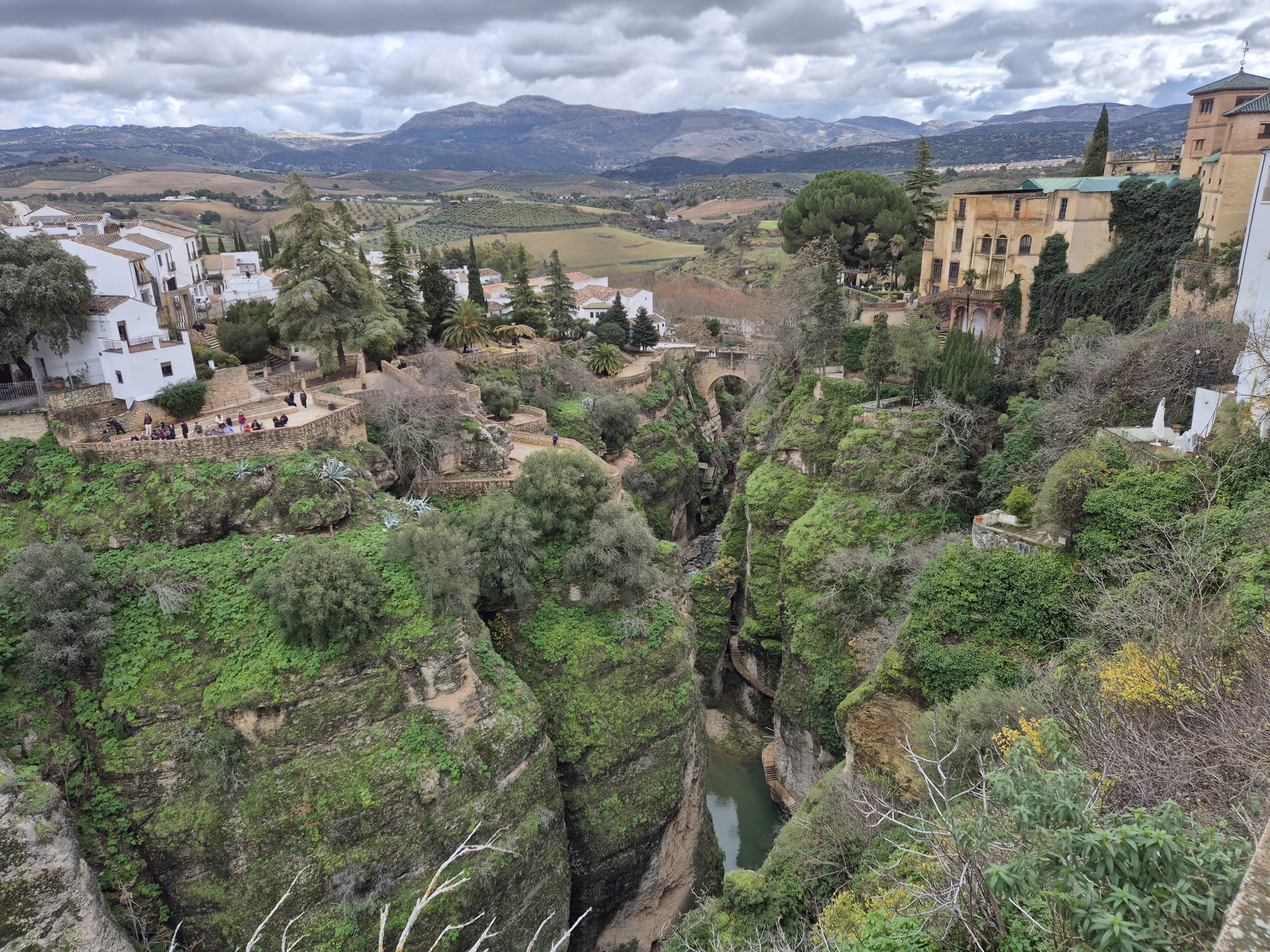
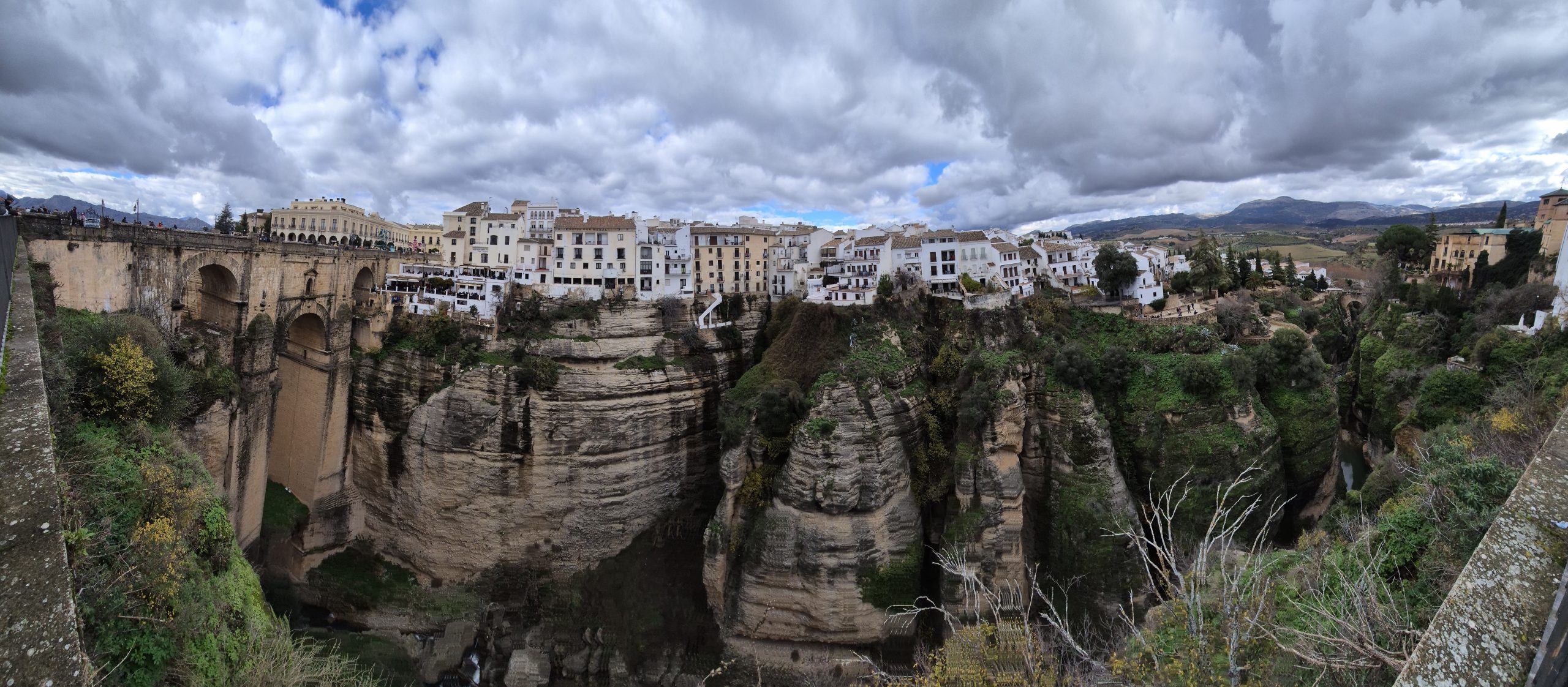
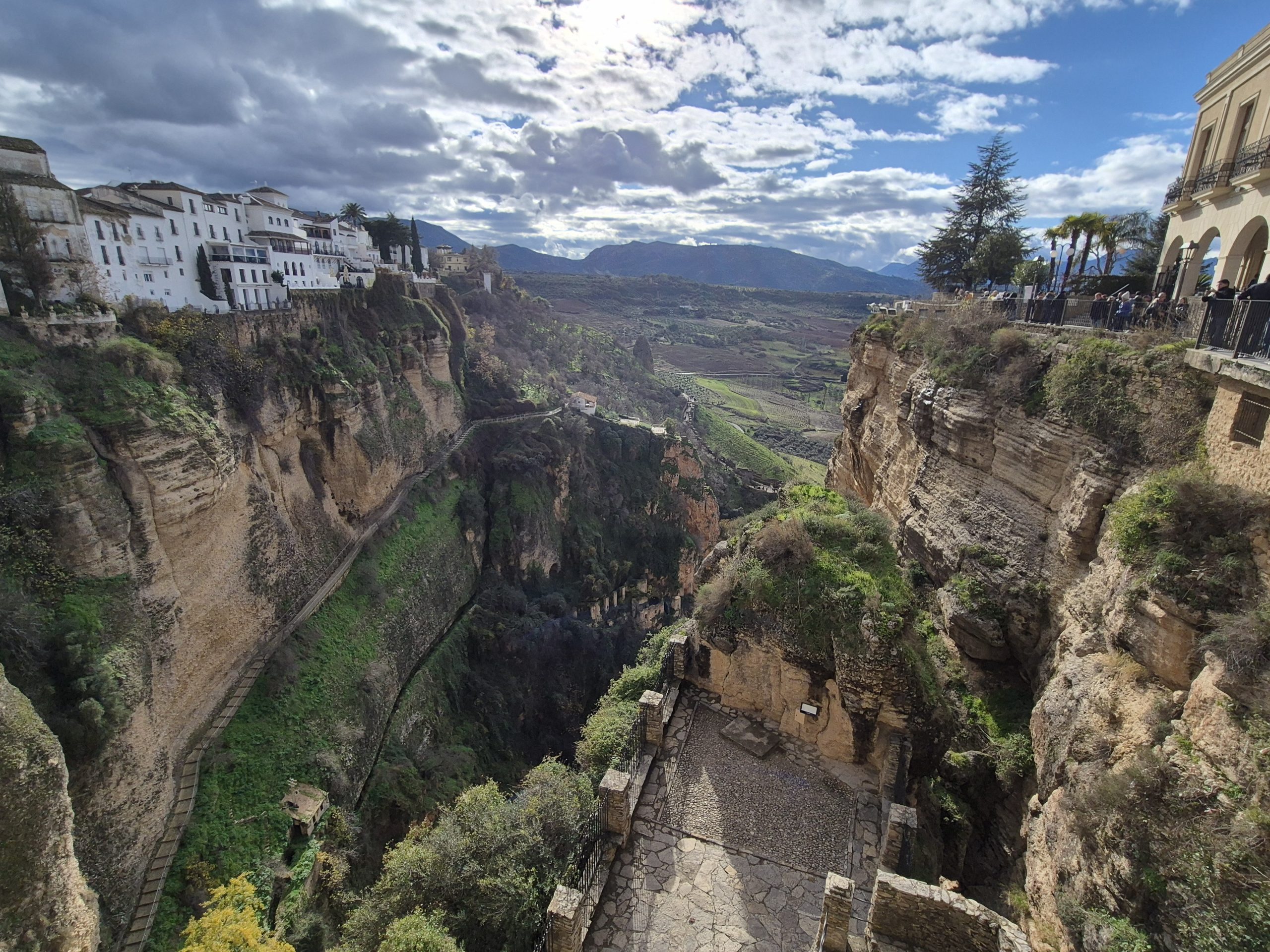
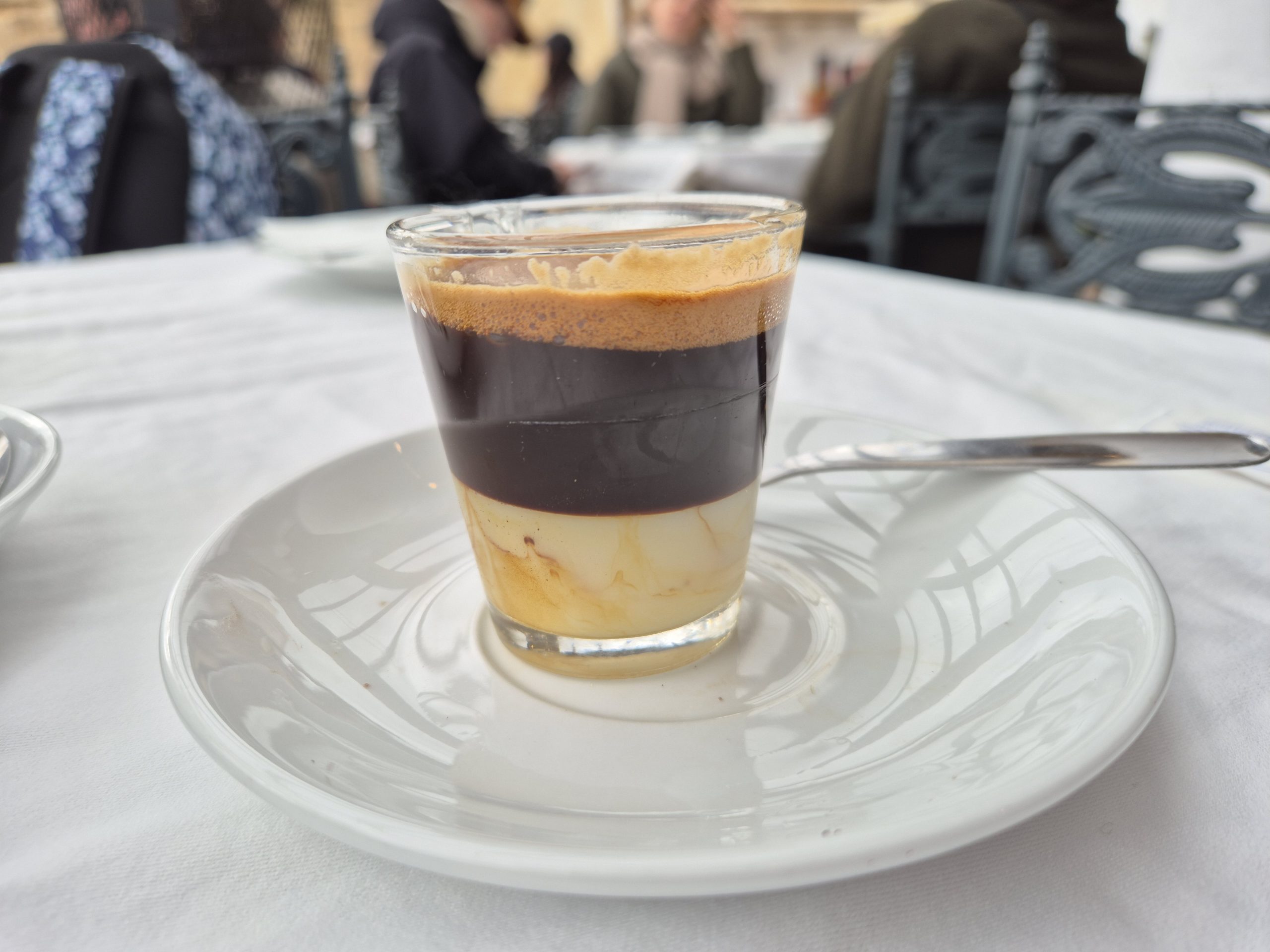
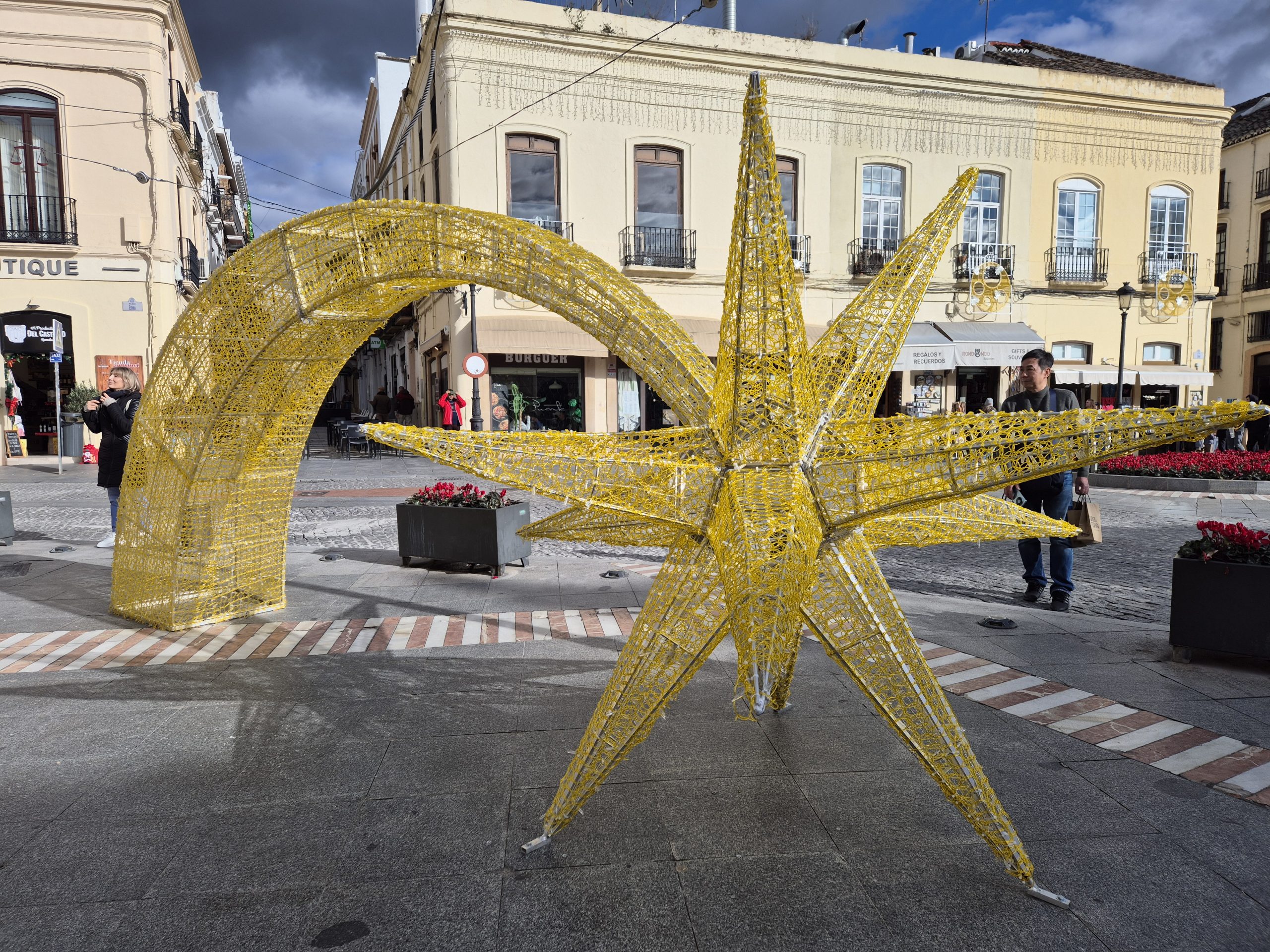
We walked around a bit to a couple of souvenir shops for postcards (my hoarding fix), and past a square which flaunted yet another falling star, less magnificent than the one I’d first seen in Valencia.
Ronda is compact: once you’ve taken in the bridge and the cliffs there isn’t a great deal more to do, and we were glad we’d driven. The single bus back left at 6pm; the car gave us the loose afternoon, and a detour on the way home.
Setenil de las Bodegas
I drove up to Setenil, collecting more Spanish miles. The detour was a side-quest within a side-quest: Setenil de las Bodegas, a small town built quite literally into the rock. Its streets run beneath huge overhangs of stone – houses and bars roofed by the cliff itself, the mountain pressing down where a sky should be – and a shallow stream threading along the bottom, between the rock-roofed rows. As a plaque quoting the poet Gerardo Diego put it:
Setenil de las Bodegas,
where the sky is made of rock
and silence is a pickaxe’s dream.
I don’t quite get the last line, but it is nonetheless charming.
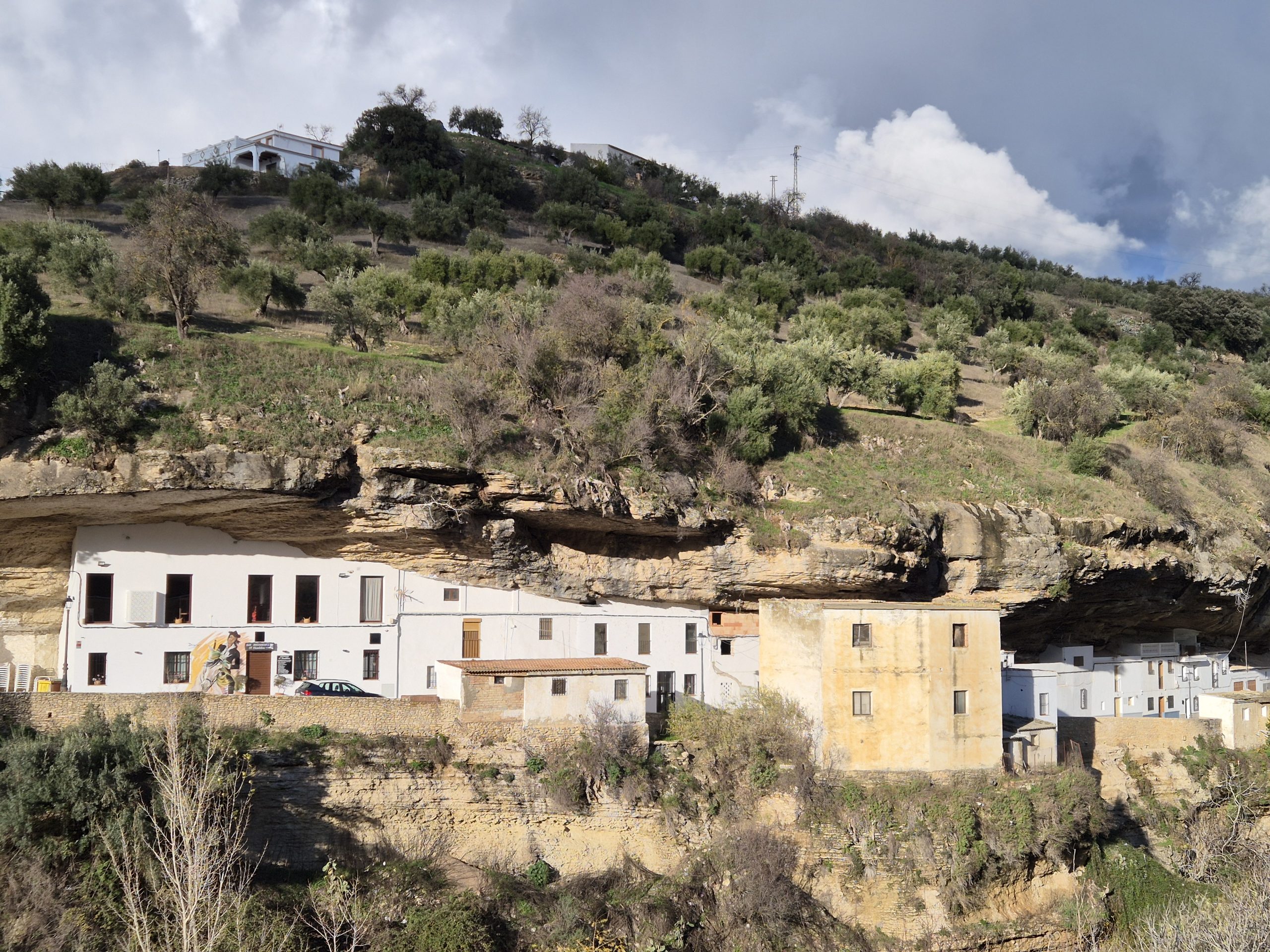
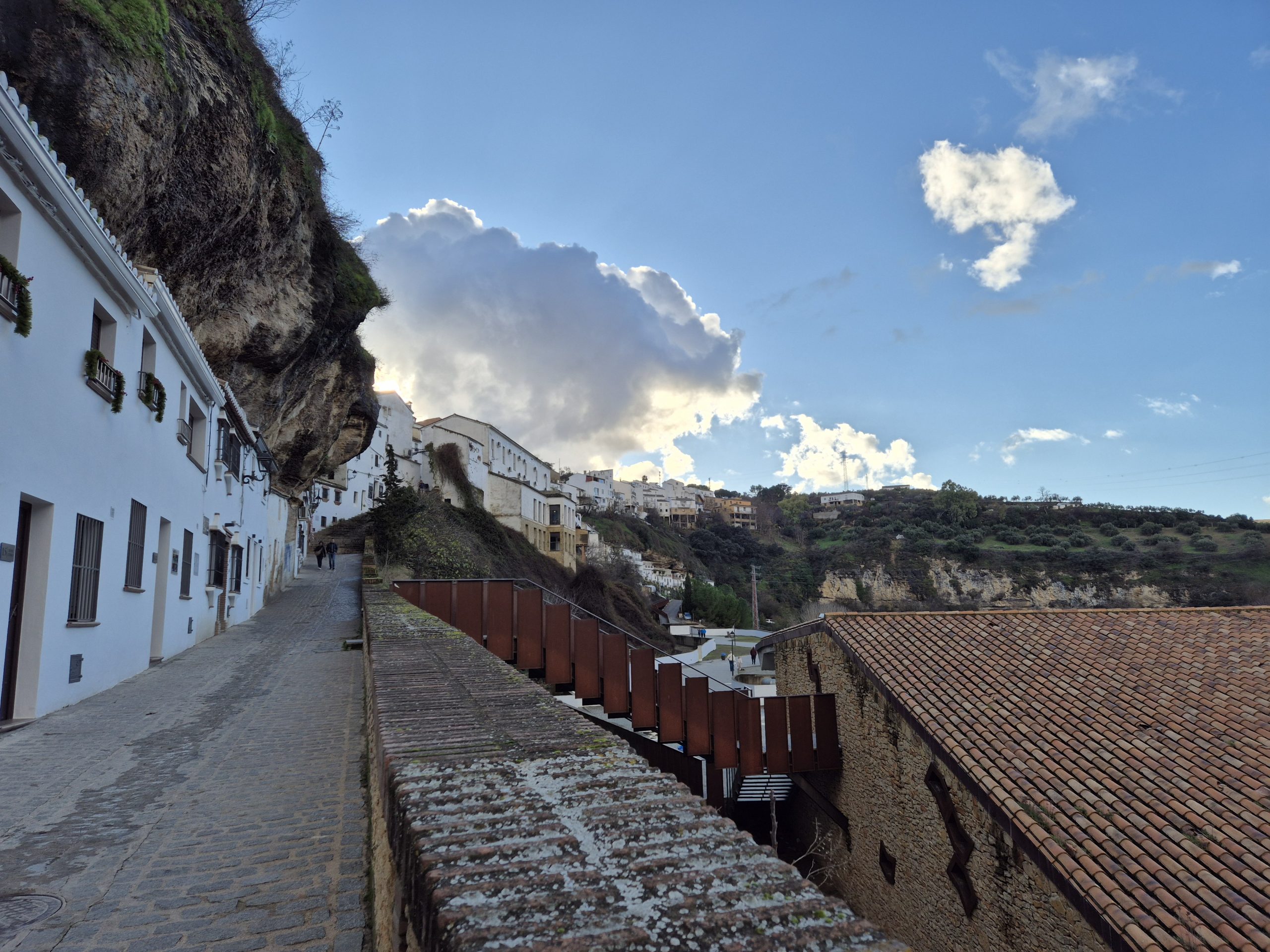
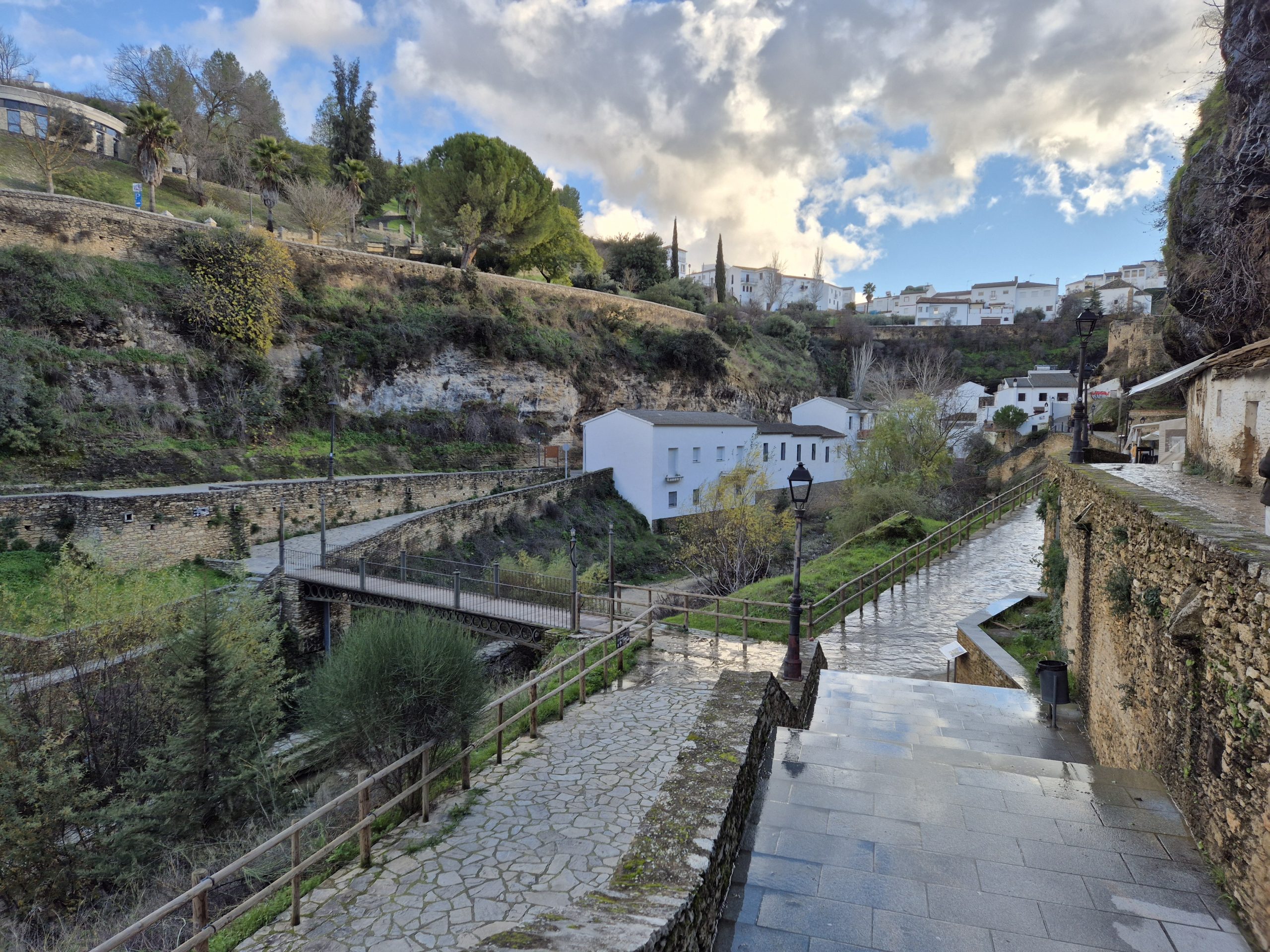
The town is cozy and strange in equal measure, and after the grandeur of Ronda’s gorge, this crouching oddity – a whole town tucked under a rock – was equally memorable.
Back to Seville
B drove us back from Setenil to Seville. I enjoyed the winding road and the view – by around 5:30pm the winter sun was setting, the sky a glorious orange, the hills silhouetted below, and a last pueblo blanco glowed white on its hillside. Car return smooth, we were back in town in time for a low-key Christmas dinner and a night walk to the Setas – but that evening belongs to the Seville story.
Of fourteen days, this was the only one we spent behind a wheel instead of on a train, and the only one without a fixed plan. It earns its own page as the trip’s pocket of restlessness – the day we chose motion over a quiet Christmas – and as a study in contrasts: Ronda’s enormous, theatrical gorge, and Setenil’s opposite magic, a town that survives by living under the landscape rather than above it.
So: did I, the freshly minted over-tourism researcher, strike a noble blow against mass tourism by fleeing to two lesser-known towns? Let’s review the evidence. We rented a car (carbon footprint: enlarged). We drove it to Ronda, whose interpretation center cheerfully informed me I was one of the millions drawn by the same two-century-old hype. Setenil was off-beat but the driving thing nullifies the positive points. Sustainable tourism, this was not. Potato day, it absolutely was. (Comes from couch-potato → potatoing – referring to taking it easy, if you’re wondering.)